
Hairstyles for an Oval Face Shape: Choose the Effect You Want
Oval describes a face that appears longer than it is wide, with no single width point dominating strongly. Any haircut can work: choose a more open, framed, horizontal, vertical, curved, or deliberately strong effect, then adapt the reference to your texture, density, hairline, growth pattern, finished dry length, and routine.

Face shape is a descriptive framework, not a diagnosis or a beauty standard. If your proportions read as oval-like, use that observation to compare placement—not to search for a haircut you are required to wear. Decide which lines you want to see, shortlist two contrasting directions, and then let your hair behavior and routine determine what is realistic.

Confirm Oval-Like Proportions Without Calling Them Ideal
An oval-like face usually appears longer than it is wide. The forehead and cheekbone area may be similar in width, while the jaw narrows gradually toward a rounded or softly tapered chin. No single width point dominates strongly. These are observations, not a test of symmetry or attractiveness.
Look at a relaxed, straight-on view before choosing this guide. Keep the camera near eye level and farther than a close selfie distance: a controlled photography study found that short camera-to-subject distances distorted measured midface features with both smartphones and full-frame cameras (PubMed). Pull only enough hair back to see the natural hairline; do not redraw the forehead by forcing every short hair away from it. Expression, head tilt, camera angle, and hairline can all change the impression.
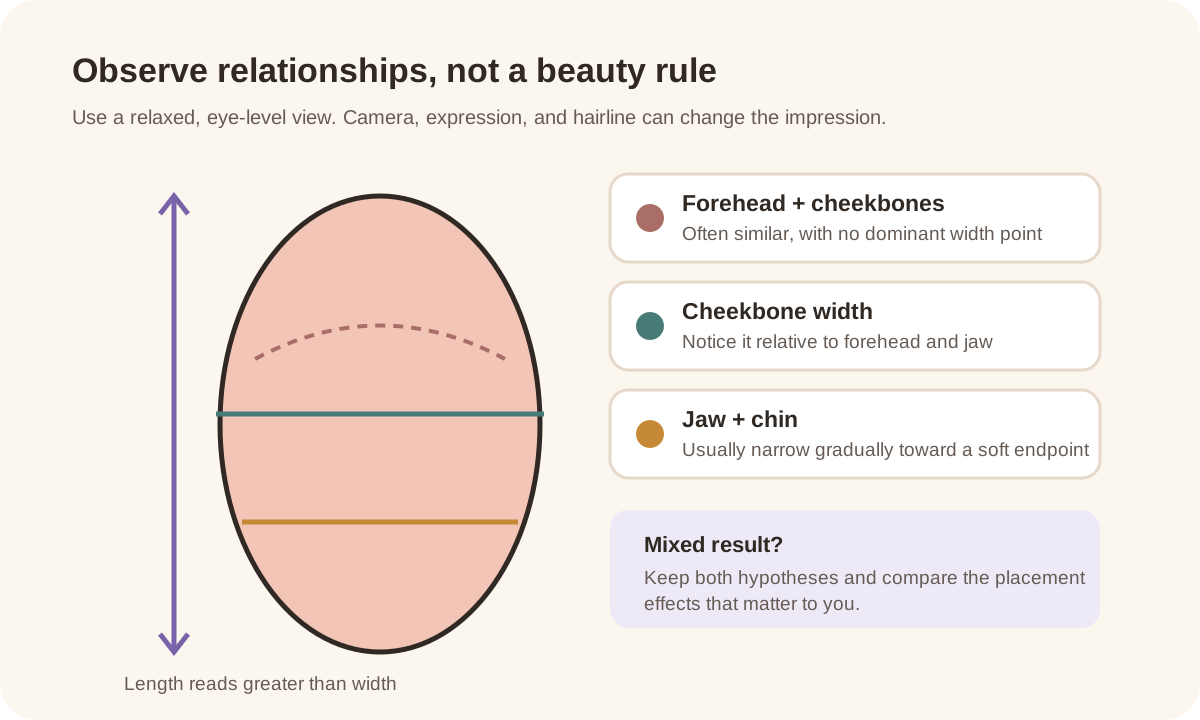
If one area looks more prominent, your result may sit between oval and another pattern. Keep both possibilities. The Face Shape Detector can help you organize observations, while the Face Shape Hairstyles Guide lets you compare the full proportion framework without forcing one label.
Your next step is to decide whether this description is close enough to make the placement examples useful—not whether every feature matches a diagram.
Start With the Effect You Want
The phrase “best hairstyle for an oval face” hides the decision that matters: what do you want the haircut to do visually? Length, volume, fringe, and parting place lines in different areas. Those lines can leave the face open, create a frame, emphasize width, repeat length, add curves, or make one edge intentionally strong.
| Effect | Placement to compare | What becomes visible | Trade-off or alternative |
|---|---|---|---|
| Open | Open forehead, swept-back sides, or compact crop | The full face outline and hairline | If you want less exposure, add a side connection or airy fringe |
| Framed | Cheek- or jaw-level face layers | Two lines that follow the sides of the face | Keep them longer if short pieces resist your routine |
| Horizontal | Chin perimeter, blunt fringe, or side volume | A clear width line at one chosen landmark | Use a softer edge when you want less graphic definition |
| Vertical | Center part, long layers, or low perimeter | Lines that continue from crown toward the ends | Add side movement if you do not want one narrow column |
| Curved | Waves, curls, curtain fringe, or rounded layers | Repeated arcs around the forehead, cheeks, and shoulders | Ask how the curve changes in your usual dry state |
| Strong line | Blunt bob, dense fringe, or defined perimeter | One deliberate edge carries the visual weight | Choose a broken or graduated edge for more movement |

- OpenOpen forehead + compact crop
- FramedCheek-to-jaw side layers
- HorizontalBlunt chin-level perimeter
- VerticalCenter part + long lengths
- CurvedRounded side volume
- Strong lineFull fringe + defined perimeter
Choose the effect you want rather than correcting your face. Your next step is to circle two contrasting effects—for example, open versus framed or curved versus strong-line—before choosing a haircut name.
Compare Length and Volume Placement
Length decides where the outer shape stops; volume decides where it expands. A pixie or crop can keep the forehead open and place its strongest line around the ear and nape. A chin bob makes the perimeter itself the decision. A collarbone lob preserves more length while side volume can create a broader middle silhouette. Long layers keep the lowest endpoint dominant and can repeat vertical movement.
Waves and curls add curved volume according to their dry pattern, not the length of a stretched strand. Crown volume draws the eye upward; side volume expands the silhouette wherever it is widest. Neither effect is inherently preferable.

Open pixie or crop
- Effect
- Open and compact.
- Trade-off
- Hairline and crown growth stay visible.
- Alternative
- Keep a longer fringe or side connection.

Chin bob
- Effect
- Horizontal and defined.
- Trade-off
- A precise edge shows length changes readily.
- Alternative
- Soften or graduate the perimeter.

Collarbone lob
- Effect
- Framed with side volume.
- Trade-off
- The finish may depend on wave definition.
- Alternative
- Use a straighter, quieter perimeter.

Long layers
- Effect
- Vertical and moving.
- Trade-off
- Subtle layers may disappear without the expected finish.
- Alternative
- Place the first layer higher or add side volume.

Curved volume
- Effect
- Curved and expansive.
- Trade-off
- The outline shifts with drying and definition.
- Alternative
- Keep more length or a stronger perimeter.
For construction and maintenance details, compare short haircut silhouettes or return to the Hairstyles and Haircuts Guide. Your next step is to shortlist one length-led option and one volume-led option, then describe their strongest visible line.
Compare Partings and Bangs
A parting creates a direction before any layers begin. A center part places two relatively vertical lines around the forehead. A side part adds a diagonal and usually shifts root volume toward one side. Your natural growth pattern may make one placement effortless and another dependent on drying or heat styling.
Fringe adds both geometry and upkeep. Curtain or wispy fringe creates an opening with curved side connections. A blunt fringe creates a more deliberate horizontal edge. Density changes how solid that line looks, while cowlicks and the natural hairline influence whether it separates, lifts, or lies flat.

Center part, no fringe
- Effect
- Open and vertical.
- Trade-off
- The natural root direction stays visible.
- Alternative
- Move slightly off-center for a softer diagonal.

Curtain or wispy fringe
- Effect
- Curved and framed.
- Trade-off
- The opening and side connection need to fall as intended.
- Alternative
- Keep longer face-framing pieces without a true fringe.

Blunt fringe
- Effect
- Graphic and horizontal.
- Trade-off
- Length, density, and separation change visibly.
- Alternative
- Choose a lighter edge or a divided fringe.
Any of these directions can be intentional. Use the Bangs by Face Shape guide to compare fringe geometry without turning it into a rule. Your next step is to photograph your natural part and hairline, then remove any reference that depends on a front section you do not want to style.
Let Hair Behavior Override the Diagram
Any haircut can be adapted when hair behavior and routine are considered. Texture describes the strand pattern, density describes how many strands occupy an area, and strand diameter describes how fine or coarse each strand feels. They are separate inputs. Growth patterns, cowlicks, hairline, shrinkage, and drying method further change where a style finishes.

Use this override checklist before keeping a reference:
- Texture and worn state: Is the reference straightened, air-dried, diffused, stretched, or shown in a natural dry pattern?
- Density and strand diameter: Would the same layering preserve the edge you want, or remove weight from an area that already feels light?
- Growth pattern and hairline: Does a cowlick redirect the fringe, lift the crown, or split the part?
- Shrinkage and finished dry length: Where must the shortest and longest points land after your usual drying method?
- Routine: Which parts require a daily reset, deliberate heat styling, or more wash-day definition than you want?
Face proportions can describe an effect; they cannot establish feasibility. Your next step is to replace a visually appealing reference if its texture, density, or finished state hides the variable most different from your own hair.
Build a Reference and Choose the Next Owner
Save two references with clearly different effects. For each one, find a front view, side view, and back view when possible. The front shows fringe and face-frame placement; the side shows volume and the strongest line; the back shows crown behavior, perimeter, and complete length. A single polished front portrait cannot communicate all three.
Copy this salon brief and complete it in plain language:
Intended effect: I want the overall direction to feel more open, framed, horizontal, vertical, curved, or strong-lined.
Finished dry length: The shortest point should land at ___ and the perimeter at ___.
Volume placement: I want the most width at ___ and the crown to feel ___.
Part and fringe: My natural part/growth pattern is ___; I want the forehead open or fringe finishing at ___.
Hair behavior: I usually wear my hair ___, and it dries/shrinks/moves like ___.
Routine: I am comfortable with ___ on wash day and ___ for a daily reset.
Non-goal: I do not want ___ to be the strongest line or maintenance demand.
Ask a licensed hairstylist to translate the effect into construction for your hair. This page owns oval-specific placement examples, not a complete cutting manual. Use the Short Haircuts guide for compact silhouettes, Bangs by Face Shape for fringe comparisons, or the Hairstyles hub to choose another haircut route.
Your next step is to bring two effect directions, three useful views, and the completed brief to a consultation.
Frequently Asked Questions
What is an oval face shape?
It is a descriptive pattern in which the face appears longer than it is wide, no single width point dominates strongly, and the jaw often narrows toward a rounded or softly tapered chin. Camera angle, expression, and hairline can change the impression, so treat an oval result as a working comparison rather than a diagnosis.
What hairstyle is best for an oval face?
There is no single best hairstyle. Decide whether you want an open, framed, horizontal, vertical, curved, or strong-line effect, then compare length, volume, parting, and fringe. The practical choice is the option that supports your preference and can be adapted to your hair behavior and routine.
Do bangs work with an oval face?
Any fringe can be considered. Curtain or wispy fringe creates a divided, curved frame; blunt fringe creates a stronger horizontal line; no fringe leaves the forehead open. Compare those effects, then check density, cowlicks, hairline, dry length, and the upkeep required to preserve the edge.
What if my face looks oval and another shape?
Keep both descriptions. Mixed proportions are common in an observational framework, and you do not need to force one label. Compare the placements that matter to you across both guides, note which effect repeats, and use your preference and hair feasibility as the deciding inputs.
Should hair texture matter more than face shape?
Texture, density, strand diameter, growth pattern, shrinkage, and routine determine whether a reference is feasible. Face shape is optional language for discussing visual placement. If the two point in different directions, adapt the placement to your hair or choose another reference that reaches the same intended effect more realistically.