
Hair Colors for Deep Summer: A Practical Comparison

If you use the label Deep Summer, first clarify what you mean by it. Compare muted deep brown, soft espresso, and cooler medium brunette as visual directions, then discuss your starting base and color history with a colorist.

Read the Color Direction Before Choosing a Look
Imagine soft deep-brown waves with a subdued neutral-cool reflection. The hair still shows individual strands, even in its darker areas. If you call this direction Deep Summer, describe that visible effect before choosing a dye name. Depth describes how light or dark the hair looks; tone describes the color direction within it. In Wella’s color chart guide, the number before the stroke indicates depth and the number after it indicates tone. That notation belongs to Wella’s system, not every brand’s.
Deep Summer is not a universally shared twelve-season category. Ask what the label means in the framework you are using rather than assuming an official definition or an interchangeable name. Here, muted deep brown and soft espresso are editorial examples: the first keeps a more recognizable brown field, while the second puts more weight on deep brown. Neither is a verdict about which shade suits you. Save a reference that shows the depth and reflection you actually want.
Compare Muted Deep Brown, Soft Espresso, and Cooler Medium Brunette
These examples separate depth, reflection, and placement so you can name the change you want. The photographs are visual references, not predictions for your hair. A shade number can help in a consultation only when you and your colorist use the same manufacturer’s chart.
| Direction | Depth and reflection | Placement to compare | Question for your colorist |
|---|---|---|---|
| Muted deep brown | Brown base with restrained neutral-cool reflection; visible strand detail through the darker areas | Mostly continuous brown, with any lighter sections kept close to the base | Which part of my current brown can stay? |
| Soft espresso | Deeper brown base with restrained reflection, rather than an opaque dark block | Deep color across most of the hair, with subtle variation where light catches it | How much deeper can we go while keeping dimension? |
| Cooler medium brunette | A brown field with a cooler, softer reflection at a comparable apparent depth | Compare the reflection before considering a change in overall lightness | Do I want a cooler reflection or a lighter overall result? |
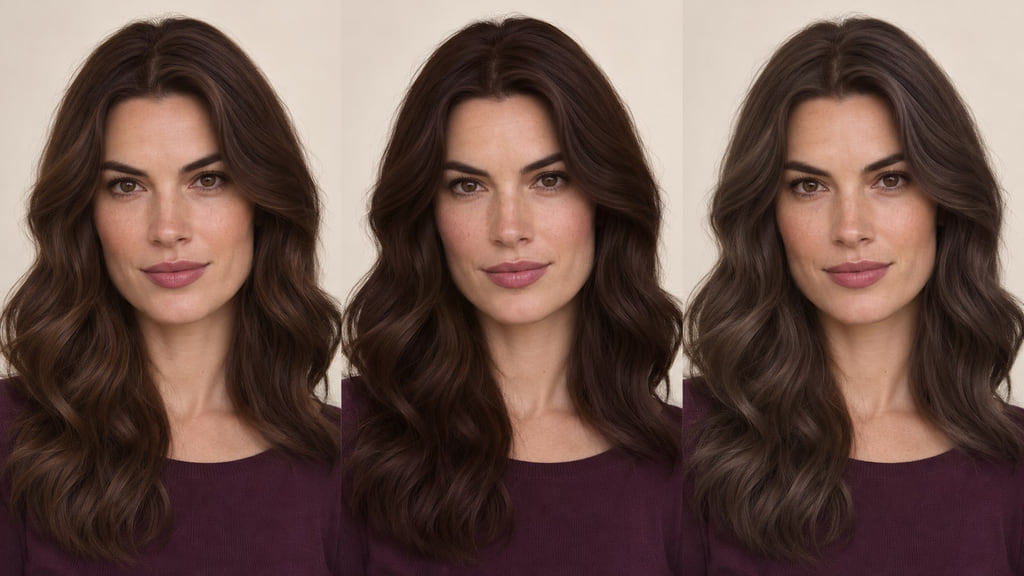
For a first choice, compare muted deep brown with soft espresso. Both keep saturation restrained and leave detail in the deeper strands, but espresso reads darker across more of the hair. If that added depth is not the change you want, compare the brown reflection with cooler medium brunette instead. Keep the face, exposure, and lighting as similar as possible when you collect your own references.
Muted Deep Brown
In this editorial example, the base stays brown and the reflection remains subdued. Look past the brightest wave: can you still see separate strands in the interior, and does the color read as brown rather than a nearly black silhouette? When comparing a second image, hold apparent depth steady and look for a change in reflection. Ask your colorist which areas of your current color should change and which should remain.
Soft Espresso
This example moves the brown field deeper while keeping a soft reflection and visible movement. A shadowed photo could make muted deep brown look like espresso, so compare the two at similar exposure. Notice the roots, interior, and ends, not just the surface shine. Ask whether the extra depth belongs throughout the hair or only in selected areas; the answer depends on your starting color and history.
Cooler Medium Brunette
Here the brown base reads cooler, without assuming an overall lighter result. To judge the reflection fairly, first compare images at a similar apparent depth and fixed white balance. Then make a separate comparison for overall lightness. Ask your colorist whether the change you like comes from cooler tone, less depth, or the placement of lighter sections.
Account for Your Starting Base
Photograph your natural roots, previously colored lengths, and ends in neutral light. Note any earlier dark color or lightened sections, along with the length you want to keep. Wella’s guide asks colorists to consider hair history and starting pigment when planning a result. A muted deep-brown reference may be close to your roots but unlike your ends; ask which areas can follow the reference now and which need another plan.
If soft espresso is your preferred image but your current hair is lighter, ask how the deeper color would grow out and what returning to a lighter direction would involve. If you prefer less visible change, a cooler medium brunette or a smaller placement shift may be a better discussion point. The label Deep Summer helps name a muted cool goal; it does not prescribe the service. If a cooler, lighter Summer direction is the question you actually want to explore, open Best Cool Summer Hair Colors (True Summer).
Plan Regrowth and Color Upkeep
Check muted deep brown in the light you usually see. Has the subdued reflection changed, or does the root now create more contrast than you want? With soft espresso, watch whether the deep areas still show strand detail and whether your natural roots stand apart from the lengths. These are cues for a conversation about refreshing color or adjusting placement, not a fixed appointment schedule.
| Direction | Daily routine question | Change to watch | Salon support to discuss |
|---|---|---|---|
| Muted deep brown | Does the brown look dimensional in your usual light? | Reflection softens or roots become more distinct | Refresh the reflection or change where subtle dimension sits |
| Soft espresso | Can you still see movement in the deepest areas? | Root contrast grows or the interior reads flatter | Maintain depth throughout or allow a softer transition |
| Cooler medium brunette | Does the cooler reflection remain visible? | Warmth or a brighter root-to-length difference becomes more noticeable | Adjust tone or rethink lighter placement |
Choose the version whose visible changes fit the routine and salon support you are willing to maintain. Your colorist can assess the actual starting hair before recommending a service or timing.
Build Your Color Reference
Save a full-outline image of the direction you like, plus a closer view of its roots, middle lengths, and ends. Add a neutral-light photograph of your own hair. Point to the area where you want to retain density and to the exact depth, reflection, and placement you want to compare. Similar exposure makes the references more useful than a mix of bright and shadowed photos.
You could say: “I want to compare muted deep brown with soft espresso. My reference is soft deep-brown waves with subdued neutral-cool reflection. Keep the natural density and show me the difference in depth, reflection, and placement before we choose a service.” This is a visual brief, not a color formula or a promise that another person’s result can be copied.
Pick one muted cool direction and bring the marked references to a colorist. You can also preview a color direction as an optional visual comparison; a screen preview cannot diagnose a season or predict the chemical color result.
Frequently Asked Questions
Is this a diagnosis or a styling framework?
It is a styling framework for comparing visible hair color. Deep Summer is not a universally shared twelve-season category, so clarify what the label means in the model you are using. Wella’s depth and tone terms describe a manufacturer’s color chart, not an individual seasonal diagnosis.
Do I need to dye my hair to fit a palette?
No. You can use the palette words to describe what you already like about your natural color. If you want a change, compare muted deep brown’s recognizable brown field with soft espresso’s deeper field and decide whether either effect is worth the upkeep for you.
How can I compare depth and reflection?
Use images with similar light, exposure, and white balance. To compare reflection, hold apparent depth as steady as you can; to compare depth, hold the reflection close. Then inspect the roots and ends as well as the surface. The result is a clearer reference for a colorist, not proof of a universal Deep Summer rule.