
Hair Colors for Soft Autumn: A Practical Comparison

Find a muted warm direction at a depth compatible with your starting base. Compare soft golden brown, muted caramel, and subdued auburn, then discuss the closest reference with a colorist. Your base and color history affect what is achievable.

Read the Color Direction Before Choosing a Look
Picture muted warm medium-brown layers with soft caramel variation. The brown stays visible, while small shifts in reflection give the layers shape. Start with that kind of controlled difference, then decide whether the warmth should read golden, caramel, or red-brown. The choice is a color direction to discuss, not a promise that your hair will match a photograph.
The Concept Wardrobe’s twelve-season framework describes Soft Autumn as muted and warm. Use that label as styling vocabulary, not as a medical diagnosis or a universally standardized classification. Warmth and brightness are separate questions: a color can have a warm reflection without becoming much lighter. Soft golden brown keeps a brown base with a quiet gold cast; muted caramel shows more brown-gold variation through selected lengths. Neither is a ranking of your appearance.
Compare Soft Golden Brown, Muted Caramel, and Subdued Auburn
Depth is how light or dark hair appears; tone is the visible color direction within that depth. Wella’s color chart guide uses the number before a stroke for depth and the number after it for tone. That describes Wella’s system, not a universal code across brands. In the examples below, compare the shade direction, the amount of lightness, and where any variation sits before discussing a service.
| Direction | Depth and reflection | Placement to compare | Question for your colorist |
|---|---|---|---|
| Soft golden brown | Medium-brown base with a restrained golden reflection | An even brown field or small golden shifts through the layers | Can I keep this brown depth while changing the reflection? |
| Muted caramel | Medium-brown base with subdued brown-gold caramel variation | Selected lighter pieces through the lengths, connected to the root | Where should the variation begin on my current base? |
| Subdued auburn | Medium-brown base with a quiet red-brown reflection | A soft tonal change or narrow pieces rather than a bright red band | How much red-brown reflection do I want to see? |
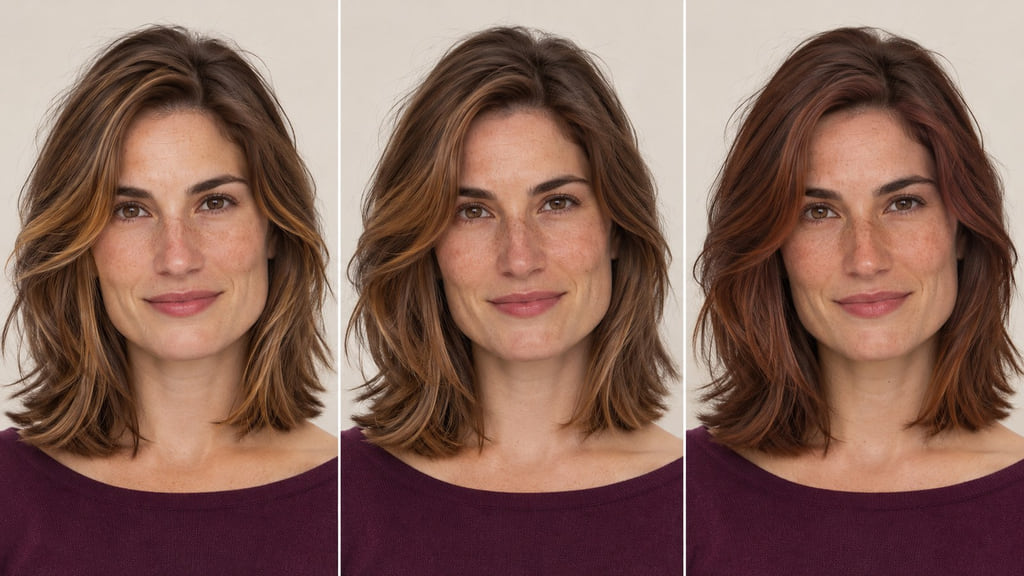
For a first choice, compare soft golden brown with muted caramel at a similar overall depth. The first emphasizes a quieter golden reflection across a brown field; the second places more brown-gold variation through the layers. If the reference for one option is also much brighter or photographed in warmer light, find a closer match before deciding which reflection you prefer.
Soft Golden Brown
This direction keeps brown as the main color and lets a restrained golden reflection show when the hair moves. In two references, hold the exposure and overall depth close so that the gold, rather than a change in brightness, is what you are judging. Ask which parts of your current brown you want to preserve and whether the shift belongs throughout the hair or in a few sections.
Muted Caramel
Muted caramel adds a brown-gold variation that can be concentrated through selected lengths. Look at the root and ends as well as the face-framing pieces: the placement may change the impression more than the name of the shade. Compare it with soft golden brown under similar light, then ask which sections should change and which should stay close to your existing base.
Subdued Auburn
Subdued auburn keeps a brown base while introducing a restrained red-brown reflection. Compare it with a brown reference of similar depth so the red direction is clear without making the auburn sample simply lighter. If you prefer a quieter effect, point to the exact area where the red-brown should be visible and ask how that reflection may change on your colored lengths.
Account for Your Starting Base
Look at your natural roots, previously colored lengths, and ends separately. A soft golden brown photo may show the reflection you want, but it cannot tell you how your current hair will reach it. Bring a photograph of your own hair in neutral light and explain your color history. If you want to keep your length or most of your natural depth, say so before selecting a service. Wella’s chart can help name depth and tone within its system; a colorist still needs to assess your starting point.
Muted caramel may be a smaller or larger change depending on where your hair is now. If your base is already medium brown, you might compare a few restrained lighter pieces with a shift in overall reflection. If your reference is much lighter than your base, ask whether you like the added brightness or the caramel tone itself. Your routine and tolerance for visible roots belong in that conversation.
Plan Regrowth and Color Upkeep
Decide what changes you are comfortable noticing. With soft golden brown, check whether the reflection still reads quietly golden in your usual light. With muted caramel, watch the connection between your natural root and the lighter lengths. Subdued auburn asks a different question: do you still like the red-brown reflection as it changes? Save photos when the color looks right to you and when you feel ready to adjust it. There is no one appointment interval that fits every base, placement, and routine.
| Direction | Daily observation | Regrowth or fading to watch | Salon conversation |
|---|---|---|---|
| Soft golden brown | Does the brown field still show the gold you wanted? | The root looking deeper or the reflection changing | Would you refresh the reflection or keep the current depth? |
| Muted caramel | Do the lighter pieces still sit where you want them? | A more visible root transition or brighter-looking lengths | Would you change the placement, tone, or both? |
| Subdued auburn | Is the red-brown still as quiet as you intended? | A shift in the visible red reflection | How much auburn do you want to maintain? |
Choose the option whose changes you would be willing to see between salon visits. Placement close to your natural root and placement through the ends may call for different conversations; your colorist can assess what your hair can support. For home color, follow the current product directions and skin-test instructions. The FDA’s hair-dye guidance explains why those instructions matter.
Build Your Color Reference
Save one neutral-light photograph of your current hair, one reference showing the whole desired outline, and a closer view showing the roots and lengths. Make sure the reference has a similar depth to the result you are discussing. Circle the area where you want variation and name the part you want to keep, such as your natural root or existing length.
You can say: “I want to compare soft golden brown with muted caramel. My reference is muted warm medium-brown layers with soft caramel variation. Keep the natural density and show me the difference in depth, reflection, and placement before we choose a service.” This is a comparison brief, not a dye formula or a guarantee that a photograph can be reproduced on your hair.
Choose the muted warm direction closest to the depth of your starting base, then take both references to a colorist. You can also preview a color direction as an optional visual step. A screen preview cannot diagnose a season, assess your hair’s condition, or predict a chemical result.
Frequently Asked Questions
Is this a diagnosis or a styling framework?
It is a styling framework. The Concept Wardrobe describes Soft Autumn as muted and warm in its twelve-season model. That vocabulary can help you compare depth and reflection, but it is not a medical diagnosis or a universal rule for your hair.
Do I need to dye my hair to fit a palette?
No. Your current hair can be the reference. Soft golden brown and muted caramel are options to compare if you want a change; a palette label does not require one.
How can I compare depth and reflection?
Use similar light, camera exposure, and framing. First check whether the samples are equally light or dark; then compare their golden, caramel, or auburn reflections. A warmer image can look brighter without the hair actually being lighter. Bring the two closest references and your starting-base photo to the consultation.