
Hair Colors for Warm Autumn (True Autumn): A Practical Comparison

Compare warm chestnut, golden brown, and muted auburn at a similar depth. Keep warmth dominant while preserving softness and variation, then ask a colorist how your starting base and color history affect the result.

Read the Color Direction Before Choosing a Look
Picture warm chestnut waves with subtle golden variation. The brown remains visible, the reflection is warm, and the lighter movement does not turn the whole shape bright. Use that as one possible direction, then compare it with golden brown at a similar depth. The difference you are testing is the visible reflection, not whether one shade has a better name.
The Concept Wardrobe’s twelve-season framework describes True Autumn as warm and muted. Here, Warm Autumn and True Autumn name that same styling direction. The seasonal label is a comparison tool, not a diagnosis or a rule requiring you to dye your hair. Soft Autumn places more emphasis on mutedness; Warm Spring is also warm but clearer and lighter in this framework. A restrained red-gold chestnut and a gold-led brown are editorial examples within the warm direction, not shades the source has verified for you.
Compare Warm Chestnut, Golden Brown, and Muted Auburn
Depth is how light or dark the hair appears. Reflection, or tone, is the color you see within that depth. Wella’s professional color chart guide uses the number before a stroke for depth and the number after it for tone. That notation belongs to Wella’s system; shade numbers and names should not be treated as universal across brands. For this comparison, hold the apparent depth and lighting steady while changing the reflection.
| Direction | Depth and reflection | Placement to compare | Ask your colorist |
|---|---|---|---|
| Warm chestnut | Medium brown with restrained red-gold reflection | Mostly continuous brown, with subtle golden variation through the waves | Can the brown base stay visible while the reflection changes? |
| Golden brown | A similar brown depth with gold as the clearest reflection | An even golden cast or narrow pieces connected to the root | Where would gold be most visible on my current base? |
| Muted auburn | A similar brown depth with restrained red-brown reflection | A soft tonal change or selected sections, without a bright red band | How much red-brown should show in ordinary indoor light? |
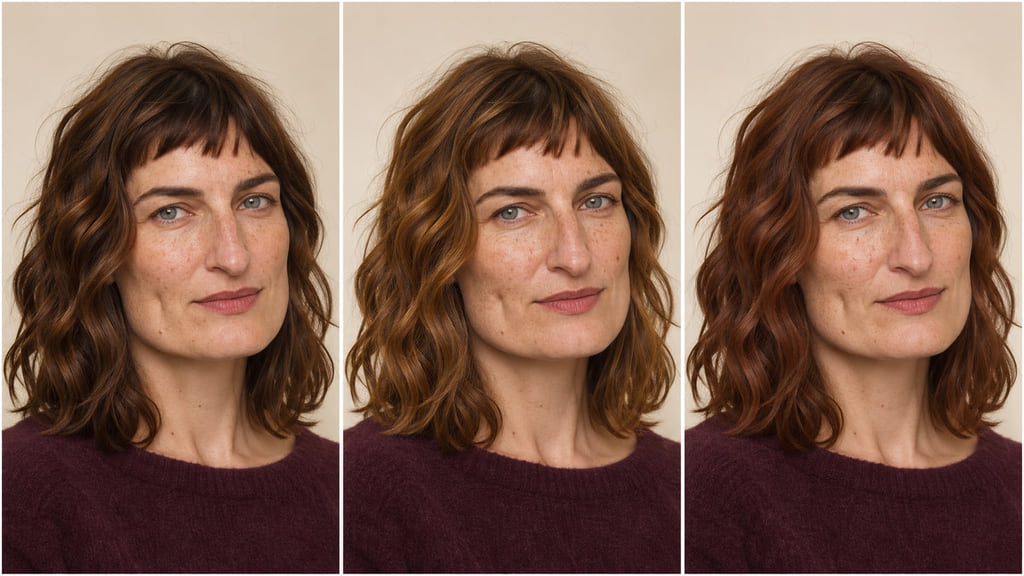
Try a two-option decision: put warm chestnut beside golden brown at the same apparent depth. Chestnut brings a restrained red-gold cast to a brown base; golden brown lets gold lead while the base still reads brown. If the second reference looks lighter as well as more golden, find a closer depth match before deciding which reflection you prefer. These are visual references for a consultation, not a promise that either result is achievable from your current hair.
Warm Chestnut
In this example, the brown base remains the largest color field and red-gold appears in reflection, with small golden shifts through the waves. Keep the face, exposure, and hair depth comparable to your golden-brown reference. If you want more variation, ask whether it should sit near the face, through the mids, or across the whole shape. The placement can change what you notice even when the shade name stays the same.
Golden Brown
Here the base is still brown, but the most obvious reflection is gold rather than red-gold. At the same depth, that shift can make the hair read more golden without asking for an all-over lighter result. Compare an even golden cast with narrow, lighter pieces; they create different patterns of brightness. Ask which area can change while your natural root remains connected to the lengths.
Muted Auburn
Muted auburn moves the example toward red-brown while keeping the saturation restrained. It is not simply a lighter chestnut. Compare it with chestnut at similar depth and in the same light so you can see whether you prefer a continuous red-brown cast or small red-gold shifts. Tell your colorist how much red you want visible indoors, where daylight can no longer do the work of the reference photo.
Account for Your Starting Base
The photograph cannot tell a colorist what your hair can reach. Wella’s guidance asks colorists to assess previous color processes and the starting base before choosing a color plan. Bring a photo of your current roots and lengths in neutral light, and disclose prior color. A natural brunette base, previously lightened ends, and a darker dyed length may call for different routes to a similar warm chestnut reference. Do not use a Wella shade number as a cross-brand prescription.
For golden brown, look at the amount and position of any existing lightness. If your reference has fine gold pieces but your hair is uniformly dark, ask what change would be needed to show that variation and what it would mean for upkeep. If your lengths are already lighter than the reference, ask how to preserve a brown foundation. Your preferred reflection is the decision; the service is something to work out from your actual base.
If you need the wider Autumn family comparison, read Autumn Hair Colors. Compare Best Hair Colors for Soft Autumn when quiet beige-brown softness matters more than clear warmth, or Deep Autumn Hair Colors when darker framing is the main decision. Keep this page for comparing warmth-led depth and reflection.
Plan Regrowth and Color Upkeep
Warm chestnut can be planned as a mostly continuous brown field or as smaller warm shifts through the lengths. Check your reference for where the root ends and brighter areas begin. If you want the root transition to stay less noticeable as hair grows, ask for a placement that connects with your natural base. If you want a clear, even red-gold reflection, ask how you would recognize when that reflection has faded beyond your preference.
Golden brown may show change first where the gold is lightest; muted auburn may prompt a refresh when its red-brown reflection no longer reads as intended. Look at your hair in the same indoor and daylight conditions each time. The table below is a planning aid, not a schedule: your starting base, service, and routine determine when you will want maintenance.
| Direction | Daily routine to consider | What to watch as it grows or fades | Salon commitment to discuss |
|---|---|---|---|
| Warm chestnut | Whether you want an even reflection or are comfortable with variation | The line between your root and the red-gold lengths; loss of the chosen reflection | Refreshing the tone or adjusting where warm pieces begin |
| Golden brown | Whether lighter pieces need styling to remain visible | Root contrast and gold that becomes brighter or duller than your reference | Placement and tone changes for any lightened sections |
| Muted auburn | How much red-brown you want to see in everyday light | A red-brown cast that fades or shifts away from the intended softness | Whether you want to maintain a more continuous reflection |
Choose the direction whose visible changes you would be willing to manage, then tell your colorist what would count as a refresh for you. There is no useful universal interval for all three options.
Build Your Color Reference
Save one neutral-light photograph showing the full hair outline and one closer view of the reflection through the mids and ends. Add a photograph of your current root and length. Match the reference depth as closely as you can before comparing chestnut with golden brown; otherwise a brighter image may win because of lighting or lightness rather than its color direction.
You can bring this salon brief:
I want to compare warm chestnut with golden brown. My reference is warm chestnut waves with subtle golden variation. Keep my natural density as it is, and show me the difference in depth, reflection, and placement before we choose a service. Here is my current base and color history. I would like to discuss what I can maintain as it grows out.
Use the brief to start a conversation, not to specify a formula. Bring the two closest photographs to your colorist and ask which depth, reflection, and placement are realistic from your base.
Frequently Asked Questions
Is this a diagnosis or a styling framework?
It is a styling framework. The Concept Wardrobe calls True Autumn warm and muted; this guide uses Warm Autumn for that warmth-led comparison. You can use those words to compare photographs without treating the label as a test of your identity or a rule for your natural hair.
Do I need to dye my hair to fit a palette?
No. Your natural color can be your reference point. Compare warm chestnut and golden brown only if you want a change, and decide whether a shift in reflection, selected pieces, or no service suits your preference. A seasonal label does not create a need for color.
How can I compare depth and reflection?
Use similar lighting, exposure, and framing. First match how light or dark the two references appear; then compare whether the brown reflects red-gold, gold, or muted red-brown. Wella’s chart separates depth from tone, but its numbering is specific to its own system. If softness leads your decision, compare Soft Autumn; if a lighter, clearer warmth leads, compare Warm Spring.