
Hair Colors for Cool Winter (True Winter): A Practical Comparison

Compare cool deep brown, neutral-cool black, and restrained red-violet without assuming that a flat black result is the goal. Look at depth, reflection, and placement in the same light, then bring the two closest references to a colorist. Your starting base and color history affect what is achievable.

Read the Color Direction Before Choosing a Look
A cool deep-brown lob with clear separation between dark strands is one possible starting reference. If you like its visible brown base, compare it with near-black hair before deciding you want more darkness. Keep the face, light, and hair outline similar in your photographs. The difference you are judging is the color direction, not whether one model or photograph looks more appealing.
The Concept Wardrobe describes True Winter as cool and bright in its twelve-season framework. Here, Cool Winter and True Winter name that cool-led direction. They offer a way to describe a visual preference, not a diagnosis or a requirement to dye your hair. Deep Winter is a neighboring, depth-led comparison; its darker emphasis is a separate decision. The brown, black, and red-violet options below are editorial examples, not shades prescribed by that framework.
Compare Cool Deep Brown, Neutral-Cool Black, and Restrained Red-Violet
First separate depth, how light or dark the hair appears, from reflection, the visible tone within that depth. Wella’s hair-color chart uses the number before the stroke for depth and the number after it for tone in its own system. Use these words to compare photographs; do not treat one manufacturer’s numbering as a universal formula. Placement asks where the different reflection or depth appears on the hair.
| Direction | Depth and reflection | Placement to compare | Question for your colorist |
|---|---|---|---|
| Cool deep brown | A visible brown base with cool reflection and separate dark strands | Subtle variation through the lengths or a more even brown field | Which part of my current brown can remain? |
| Neutral-cool black | Near-black depth with a restrained cool reflection and visible strand detail | A continuous dark field or slight separation near the face | Would this depth hide variation I want to keep? |
| Restrained red-violet | A deep base with a visible red-violet reflection rather than added lightness | Reflection across the whole length or selected sections | Where could the reflection remain readable on my base? |
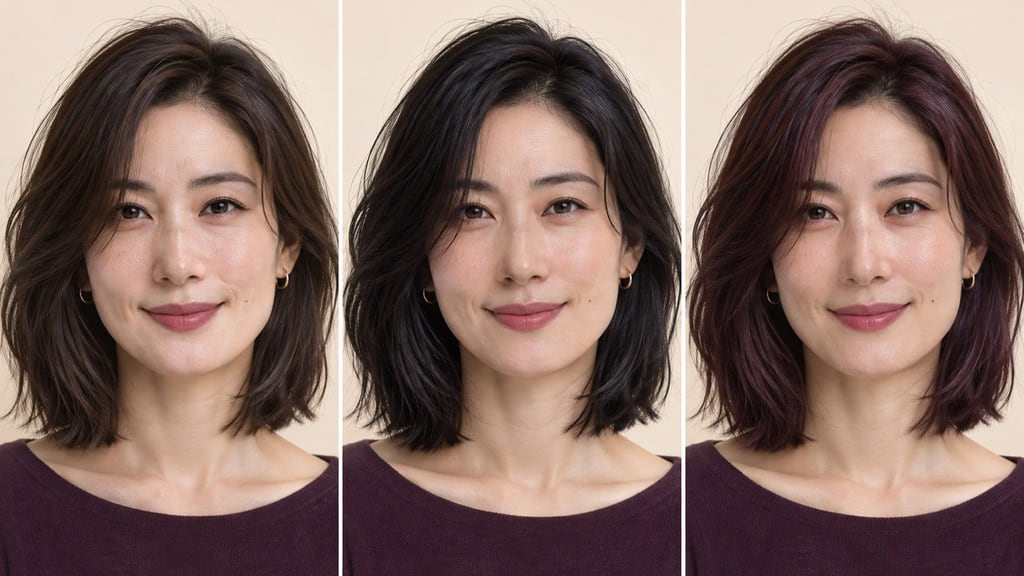
For a first choice, put cool deep brown beside neutral-cool black. In option A, you can still name the brown base and follow individual strands through the deeper areas. In option B, the overall field is nearer black, but the strands should remain visible. If the darker image only seems stronger because its exposure is lower, find a better-matched pair before discussing a service.
Cool Deep Brown
Use a brown base with clear dark-strand separation as the editorial example. Hold the face, exposure, and approximate hair length steady while comparing a cooler reflection with your current one. If you are comparing depth instead, keep the reflection as similar as you can. Ask which part of your present brown you would keep and where you would want a visible change.
Neutral-Cool Black
This example moves toward near-black depth while preserving separation between strands. Compare it with deep brown under the same light: does the darker field still show the movement you want? A cool reflection does not require a hard blue cast or a solid block of black. Ask whether to change the whole depth or only the sections that make the reference look darker.
Restrained Red-Violet
Here the change is a red-violet reflection over a deep base, with red still visible. It is not simply a lighter version of the brown or black examples. Compare photographs at a similar depth and exposure so the reflected color, rather than brightness, drives the choice. Ask which sections would need that reflection and which parts of your current color should remain quiet.
Account for Your Starting Base
Photograph your natural roots, previously colored lengths, and ends before choosing a reference. Note the length you want to retain and whether you want a subtle shift or a clearly different depth. A cool deep-brown photograph can describe the target, but it cannot show what your particular hair can reach or how a service will affect it. A colorist can assess the current base and history before deciding on a process. If a shade chart comes up, identify its manufacturer rather than assuming the code transfers across brands.
If near-black looks compelling in a reference but feels too far from your current hair or routine, take both the near-black and deep-brown images to the consultation. Ask whether the brown base can stay visible while the reflection or placement changes. This keeps your goal focused on cool dominant directions without committing to flat black. For adjacent comparisons, Bright Winter emphasizes a different clarity decision, while Deep Winter explores a depth-led one.
Plan Regrowth and Color Upkeep
For cool deep brown, check how the reflection looks in ordinary light and whether the original strand separation still reads. Notice the boundary between your natural root and colored lengths, then decide whether you want to adjust the tone, the placement, or neither. With neutral-cool black, ask whether a stronger root-to-length difference or a flatter-looking field would bother you. Your hair history and chosen placement matter more than a universal appointment interval.
| Direction | Everyday observation | Regrowth or fading to watch | Salon support to discuss |
|---|---|---|---|
| Cool deep brown | Can you still see brown and separate dark strands? | A changed reflection or a root-to-length boundary | Whether to refresh tone or keep the present placement |
| Neutral-cool black | Does the deep field still show strand detail? | A more visible natural root or a shift in the dark reflection | Whether the depth needs maintenance you want to make time for |
| Restrained red-violet | Is the red-violet reflection still readable in ordinary light? | A quieter reflection or a different-looking root | Whether to maintain selected sections or the wider color field |
Save a photograph when you like the color and another when you begin to want a change. Those observations make your tolerance for upkeep clearer than a fixed schedule. Discuss the daily styling needed to show the chosen placement as well as any future color service.
Build Your Color Reference
Save a front view of the cool deep-brown lob that shows the whole outline, then add a side or back view showing the root and lengths. Include a neutral-cool black reference photographed in similar light. You can use this request at a consultation:
I want to compare cool deep brown with neutral-cool black. My reference is a cool deep-brown lob with clear dark-strand separation. Keep the natural density and show me the difference in depth, reflection, and placement before we choose a service.
That request explains the effect you want to compare; it is not a color formula. Choose the direction you prefer from the two references and discuss it alongside photographs of your actual starting hair. You can also preview a color direction as an optional visual step. A screen preview cannot diagnose a season or predict the chemical result of coloring your hair.
Frequently Asked Questions
Is this a diagnosis or a styling framework?
It is a styling framework. The cited twelve-season model describes True Winter as cool and bright; the examples here translate that language into choices about depth and reflection. It cannot classify your hair or prescribe a service. Use the reference photographs to explain the visible result you prefer.
Do I need to dye my hair to fit a palette?
No. You may prefer the brown depth and cool reflection already present in your hair. If you are considering a change, compare that existing color with neutral-cool black at the same exposure before deciding whether more depth adds anything you want.
How can I compare depth and reflection?
Keep lighting, camera settings, and hair outline as consistent as possible. Compare depth first by asking how much brown remains visible; then compare the cool or red-violet reflection at a similar depth. This is a Cool/True Winter color-direction exercise. If the decision is mainly about near-black depth, use the separate Deep Winter comparison.