
Hair Colors for Gray Hair: Depth, Reflection, and Choice

Choose whether to keep gray visible, add dimension, or discuss coverage. Compare natural silver, lowlight dimension, partial blending, and fuller coverage under similar light. Your starting base and color history affect what a colorist can achieve.

Start with the visible result you want: keep silver and white strands in view, add selected depth, soften some contrast, or show less gray overall. Use the four directions below as references for a colorist. A photo shows a goal, while your natural base and previous color determine the route to it.
Read the Color Direction Before Choosing a Look
In a naturally silver bob, white, silver, and remaining pigmented strands can form a visible pattern rather than one uniform metallic surface. First decide how much of that pattern you want to retain. Then compare depth (how light or dark the hair looks) with tone (its color direction). In Wella’s color chart, the number before the stroke indicates depth and the number after it indicates tone. Those numbers describe Wella’s system; they aren’t universal shade codes or a formula for your hair.
Natural silver keeps the existing variation in view. Lowlight dimension introduces selected deeper strands while retaining silver between them. These are different visibility goals, not a ranking of appearances. If your goal is the method of connecting gray roots to older color, see the separate Gray Blending Ideas guide.
Compare Natural Silver, Lowlight Dimension, and Partial Blending
Compare each direction by what changes in depth, reflection, and placement. Hold the lighting and framing steady when you save references; a warmer lamp can make a neutral silver look different without any color change. Use your starting base to decide which direction to discuss with a colorist.
| Direction | Visible gray | Depth and placement | Ask your colorist |
|---|---|---|---|
| Natural silver | Silver, white, and remaining pigmented strands stay visible together. | Keep the current variation rather than flattening it into one gray surface. | Which areas already have the variation I want to preserve? |
| Lowlight dimension | Silver remains visible between selected deeper strands. | Break up a broad light area with depth in chosen sections. | Where would deeper pieces add separation without covering too much silver? |
| Partial blending | Some gray stays visible, with less contrast in selected areas. | Change specific transitions while leaving other strands apparent. | Which visible boundary should soften, and which should remain? |
| Fuller coverage | Fewer gray strands are visible in the finished direction. | A more continuous colored field can create a clearer line against new silver growth. | How much coverage is realistic on my roots and colored lengths? |
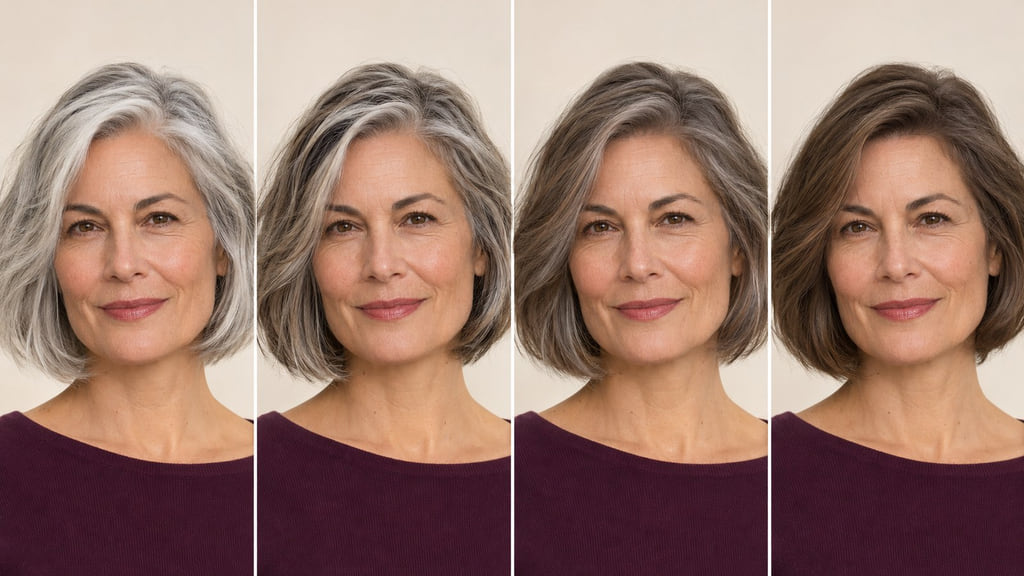
For a first comparison, save A, natural silver with white and darker strands visible, and B, lowlight dimension with selected deeper strands breaking up a broad silver area. Look at how much silver remains between the darker pieces. That distinction gives your colorist a more useful question than “Which gray shade is best?”
Natural Silver
Keep silver, white, and remaining pigmented strands visible together. In the first comparison panel, the white face frame and darker interior both contribute to the look. A different reflection in the same light can change how cool or warm it appears, while a different depth changes the contrast more substantially. Ask which part of your existing pattern should stay untouched.
Lowlight Dimension
Selected deeper strands can separate a wide silver area without suggesting that pigment has returned to gray hair. Compare the second panel with the first while holding the bob length, face, and exposure steady. Check both the width and depth of the darker pieces; either can make them more noticeable. Ask how much silver would remain visible around your part and face.
Partial Blending
This direction leaves some gray visible while reducing the contrast of selected sections. The third panel is an example of the desired appearance, not a prescription for highlights, lowlights, or a product. Mark the specific transition you want softer, then let the colorist assess how to reach it on your base. For technique choices, use the dedicated gray-blending guide.
Fuller Coverage
If your priority is seeing fewer gray strands, show a reference that includes the root and lengths, as in the fourth panel. Fuller coverage is a visibility goal; it doesn’t name a universal shade or service. Ask how your current gray pattern and previously colored hair may affect the result and the contrast of new growth.
Account for Your Starting Base
Record your natural root depth, where silver is concentrated, any previous color through the lengths, and how much length you want to keep. A naturally silver bob with untouched ends starts from a different place than one with old dark color below silver roots. Wella’s depth and tone terms can help describe the visual difference, but its numbering cannot establish what either head of hair can achieve.
For lowlight dimension, show the colorist a same-light image of your part, temples, and ends. If your lengths already contain deeper color, ask whether added depth would create the separation you want or make the silver area look narrower. If the issue is specifically a darker root transition, compare Root Shadow vs. Root Smudge. If the deciding factor is your routine, use Low-Maintenance Hair Colors to compare the upkeep trade-offs. Keep your shade or coverage goal separate from the technique used to reach it.
Plan Regrowth and Color Upkeep
With natural silver, watch whether the reflection through the lengths still looks like your reference; natural variation may remain even as your usual styling changes. With lowlights, watch the deeper pieces against returning silver at the part and temples, and whether their depth or tone shifts. Ask about refreshing the placement when the difference matters to you, rather than assuming one appointment interval fits everyone.
| Direction | Everyday routine | Change to watch | Salon support to discuss |
|---|---|---|---|
| Natural silver | Check its reflection in your usual light. | Surface tone or styling may alter how the variation reads. | Whether any tonal adjustment supports the natural pattern. |
| Lowlight dimension | Notice the deeper pieces with your usual part and styling. | Silver regrowth and fading may change their contrast. | When the chosen depth or placement needs revisiting. |
| Partial blending | Check the selected transition, not only the overall color. | The softened boundary may move or change in tone. | Which sections need attention while gray remains visible. |
| Fuller coverage | Check the root line and lengths separately. | Returning silver may contrast with the colored field. | How to maintain or later change the coverage goal. |
Choose the direction whose visible changes and salon support you are willing to manage. A description such as “low maintenance” is useful only after you name the root line, fading, and routine you would accept.
Build Your Color Reference
Save the comparison panel closest to your goal, plus one photo of your own hair showing the part, temple, roots, and ends in consistent light. Add a side view if the silver distribution changes around your head. Here is a salon brief you can adapt:
“I want to compare natural silver with lowlight dimension. My reference is a naturally silver bob with visible variation between strands. Keep my natural density in mind and show me the difference in depth, reflection, and placement before we choose a service. My roots are ___, my lengths have been colored ___, and I want ___ gray to remain visible.”
Bring the two references and your color history to a colorist. You can also preview a color direction to compare broad appearances, but a screen preview cannot predict the dye result, the response of old color, or future fading. Choose whether to keep gray visible, add dimension, or discuss coverage; then ask which route is feasible on your starting base.
Frequently Asked Questions
How do I compare these shades at a similar depth?
Use images with similar exposure and lighting, then compare how much light or dark hair appears in the same areas. Separate depth from tone: Wella’s chart uses one part of its code for each, but the code is specific to its system. Ask whether the reference differs in overall depth or mainly in reflection and placement.
Does my starting color change the achievable result?
Yes. Natural silver alongside untouched pigmented strands gives a different starting pattern from silver roots over previously colored lengths. For natural silver versus lowlight dimension, show the colorist both areas and ask where added depth could sit without losing the variation you want to keep.
Can a virtual preview predict the dye result?
No. It can help you compare a visual direction under a chosen image, but it cannot establish how a color product will behave on your roots and lengths. Keep the shade and coverage decision here; use Gray Blending Ideas if you need to discuss a transition technique.