
Haircuts for Wavy Hair: Shape, Texture, and Upkeep

Choose a cut that works with your wave pattern and preferred styling effort. Compare a wavy lob, soft shag, long layers, and a shorter textured bob by their dry outline, front pieces, and daily routine.

Read the Cut Outline Before Choosing a Look
Begin with your hair as you normally wear it, after it has dried. Find the perimeter, or outer edge, and note where your waves separate into groups. The best haircut for your wavy hair is a shape whose visible edge, shorter sections, and styling routine you can describe and maintain. A wavy lob can keep a clearer lower line; a soft shag moves more of the interest toward the crown and front.
Layers are sections cut to different lengths. Their placement changes where the cut appears to carry weight and how clearly its cutting lines show. Sam Villa’s layering guide explains those visual differences through horizontal and vertical sectioning. Use that language to discuss an outline, rather than asking for one cutting method from a photo. No cut guarantees that your waves will air-dry into the same shape as a model’s.
Compare Wavy Lob, Soft Shag, Long Layers, and Shorter Textured Bob
These are four editorial examples, not a ranking for every wave pattern. Look at the dry endpoint, the shortest front or crown section, and where the cut appears fullest. Keep the starting density in mind when comparing photos.
| Shape | Dry perimeter | Shortest visible section | Where the weight reads |
|---|---|---|---|
| Wavy lob | Clear edge near the collarbone | Modest internal layers | Mostly near the lower outline |
| Soft shag | Broken, connected edge | Crown layers and a joined fringe or face frame | Higher around the crown and face |
| Long layers | Long edge retained | Sections beginning inside the length | At the ends, with movement above them |
| Shorter textured bob | Defined edge around the jaw | Restrained layers and separated ends | A compact shape above the shoulders |
For a concrete comparison, choose a wavy lob if your reference priority is a collarbone edge with separated waves. Choose a soft shag reference if you want shorter crown sections, a connected front, and a more broken lower line. Ask your stylist which of those visible changes your current length and density can support.
Wavy Lob
The lob makes the dry endpoint easy to point out against the collarbone. In this example, wave groups remain separate and the layering is restrained enough that the lower edge still reads as one line. Show your stylist the length you want after drying, and ask where the shortest internal layer would begin on your hair.

Soft Shag
A soft shag places shorter sections at the crown and connects them to a fringe or face frame. Its edge looks less continuous than the lob’s, while the front sections still belong to the same outline. Ask where the fringe would fall when your waves dry and how much separation you want through the crown.

Long Layers
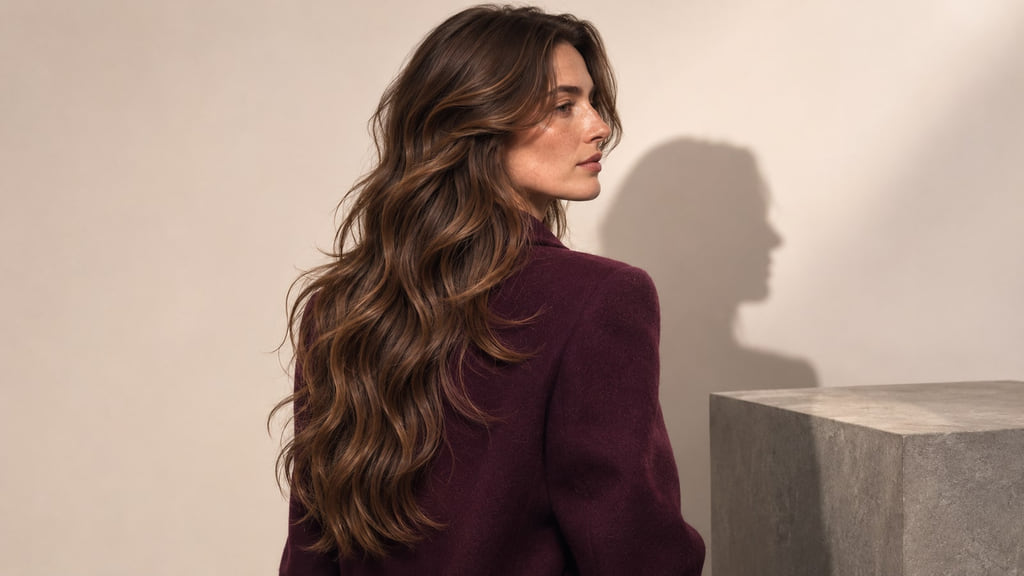
Long layers preserve a lower length while shorter sections move inside it. In the reference below, the ends still define the outline and the internal waves start higher. Point to the shortest section you would accept; if your ends are already sparse, ask how much of the lower line can stay intact.
Shorter Textured Bob
This bob has a dry endpoint near the jaw, so the shorter length is visible against a clear facial landmark. Separated wave groups soften its edge without hiding it. Ask how your waves would gather at this length and whether you want the edge to look compact or more broken.

Account for Texture, Density, and Growth Direction
Compare a reference with your hair at its usual dry length. Waves can gather differently across the head, and a natural part or growth direction can move a fringe away from the photographed position. Density describes how much hair grows in an area; it is separate from the thickness of one strand. A photo with a fuller perimeter cannot promise the same edge on a different starting density.
For a lob, bring a photo of your own dry hair and point to the collarbone landmark you want. For a shag, show where your front sections naturally split and ask how the shorter crown layers would connect. Face shape can help describe proportions, but it is only one consideration alongside texture and density, as Sam Villa’s haircut consultation guide explains. For a different texture decision, see Best Haircuts for Curly Hair by Length and Shape, Curly Bob Haircuts, or Best Haircuts for Straight Hair.
Plan Styling and Grow-Out
Think about how your waves behave after your usual wash, then how much resetting you are willing to do on an ordinary morning. A lob makes a moved lower edge noticeable. A shag may need attention to its fringe and crown separation. Long layers can change where movement begins as they grow; a shorter bob makes the jaw-length endpoint especially visible. None of these names promises effortless air-drying.
| Shape | Daily check | Grow-out sign | Salon conversation |
|---|---|---|---|
| Wavy lob | Does the lower edge settle with your usual drying method? | The edge moves below your chosen landmark | How clearly do you want to keep that line? |
| Soft shag | Can you reset the fringe and crown as you like? | The front connection or crown separation softens | Which shorter section matters most to refresh? |
| Long layers | Do the shorter sections move without a full restyle? | Movement begins lower than you prefer | How much length should remain at the edge? |
| Shorter textured bob | Do the ends hold a shape you like when dry? | The jaw-level endpoint drops and changes the outline | How precise should the short perimeter stay? |
If you prefer a simple routine, tell your stylist what you actually do rather than asking for a universally low-maintenance cut. Decide which detail you would notice first as it grows: the perimeter, the fringe, or the placement of volume.
Build Your Haircut Reference
Save a full-outline photo and a front or side view of the option you like. Add a photo of your own hair dry and styled in its normal way. Mark the endpoint, shortest section, and amount of visible separation you want. Compare the reference with your own hair after it dries so you can describe the shape you prefer without assuming the same wave pattern.
Here is a salon brief you can adapt: “I want to compare a wavy lob with a soft shag. My reference is a naturally wavy lob with separated wave groups. Keep my natural density and show me the difference in perimeter, front framing, and crown shape before we choose a service. My waves separate around my cheeks, and I usually let them dry with minimal styling. Can you show me where the shortest dry layer and any front pieces would fall on my hair, and what I would need to reset each morning?”
Frequently Asked Questions
How will this shape work with my natural texture?
The photo shows one person’s dry texture, density, and styling. Compare its perimeter and layer placement with your own dry waves; face shape is only one reference alongside texture and density. Ask your stylist how those details could translate to your starting hair rather than expecting an identical wave pattern.
What changes as the cut grows out?
A lob’s lower edge can move below its chosen landmark. A soft shag’s crown and front connection may lose some separation. Decide which visible feature matters most to you, then ask which part you would refresh first.
What should I show my stylist?
Bring a full-outline reference, a front or side view, and a photo of your own hair at its usual dry texture. Point to the perimeter, shortest layer, and volume placement you want to discuss. Explain your routine; a cut cannot promise effortless air-drying or the same wave behavior as the photo.