
Hair Colors for Brown Skin: Depth, Reflection, and Choice

Choose a color direction by starting depth, preference, and placement across brown skin tones. Compare honey accents, caramel dimension, espresso, and copper. Treat the result as a direction to discuss with a colorist; your starting base and color history affect what is achievable.

Read the Color Direction Before Choosing a Look
Picture deep brown coily hair with narrow caramel sections. The brown base remains visible, while the lighter pieces change where your eye finds movement. That is a useful starting point for choosing a color direction: decide how much depth you want to keep, which reflection you prefer, and where the difference should sit.
Depth describes how light or dark hair appears; tone describes its color direction within that depth. Wella’s hair color chart uses the number before the stroke for depth and the number after it for tone. Those codes belong to Wella’s system, but the distinction helps you describe a photograph to a colorist.
Brown skin spans a range of depths and undertones; it is not one palette. Honey accents and caramel dimension create different visible effects, and neither is a universal choice for brown skin. Look at the hair beside your own features in consistent light, and decide whether you prefer a golden glint or a quieter brown-gold change.
Compare Honey Accents, Caramel Dimension, Espresso, and Copper
Use the same light and a similar starting depth when comparing reflections. The examples below describe visible differences, not results that every base can reach. Keep the natural brown field in view so placement does not disappear behind a shade name.
| Direction | Depth and reflection | Placement to compare | Ask your colorist |
|---|---|---|---|
| Honey accents | Deep brown base with restrained honey-gold reflection | Narrow selected sections against the visible base | Where could a small golden difference be seen in my usual style? |
| Caramel dimension | Deep brown base with brown-gold caramel reflection | Selected sections through the lengths, with the base retained | How broad should the caramel pieces be? |
| Espresso | Deep brown with quieter reflection and visible strand detail | An overall dark field or subtle variation within it | Will this depth still show the texture I want to see? |
| Copper | Brown depth with visible orange-red reflection | Selected sections or a wider color field | How much copper do I want near my face? |
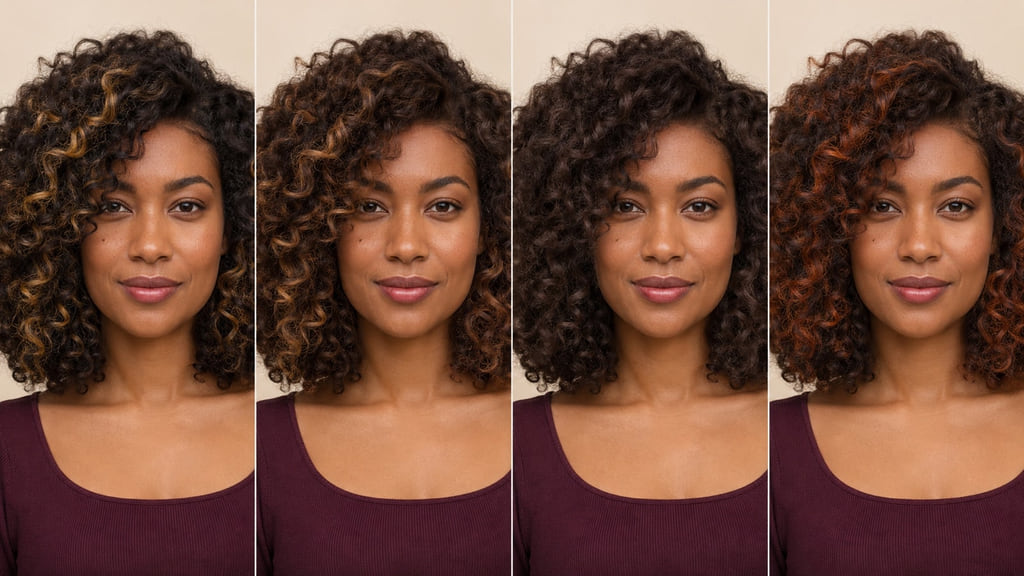
For a first choice, compare honey accents with caramel dimension. Honey brings a narrower golden glint to selected coils; caramel reads more brown-gold across selected sections. Keep the face, exposure, and base depth steady while you decide which difference you actually want. Then use espresso and copper to test whether you prefer less or more visible reflection.
Honey Accents
Narrow honey-gold sections catch light while deep brown remains the main color. Compare them with caramel pieces at similar depth and fixed white balance. Ask which part of your usual hairstyle should show the brightness and which dark areas should remain intact.
Caramel Dimension
Here, brown-gold sections add a softer change through the coily lengths while preserving the deep base. Their width and position affect whether the color reads as a few points of light or a broader band. Ask to see placement in a reference with hair worn as you normally wear it.
Espresso
Espresso keeps the overall field deep brown. In a well-lit reference, look for strand detail inside the darkest areas rather than a featureless dark block. Compare it with your current hair at a similar angle and ask whether you want a change in depth, reflection, or both.
Copper
Copper adds a visible orange-red reflection. Compare it with a brown reference at similar depth and fixed white balance so the reflection is the main difference. Decide whether you want it in selected sections or across more of the hair; neither placement is a universal match for brown skin.
Account for Your Starting Base
Your natural roots, previously colored lengths, and ends may start from different depths. Photograph each in neutral light before choosing a reference. Also notice how much contrast you want against your brows and skin, and whether the color should appear in coils near your face or farther through the lengths. Wella’s starting-point guidance asks colorists to consider hair history before planning a target shade.
If your hair is already deep brown, espresso may be a question of reflection rather than a large change in lightness. Honey accents may call for a different conversation if your lengths have old color. A photograph shows the effect you want; it cannot determine the service your hair needs. For a wider comparison of skin depth and undertone, see Hair Color by Skin Tone. The fair and pale skin and medium skin tone guides address those separate starting points.
Plan Regrowth and Color Upkeep
Choose the visible change you are comfortable maintaining. With honey accents, check whether the narrow golden sections still read clearly in your usual style. With caramel dimension, watch whether the brown-gold reflection and the root transition still match your reference. For espresso, decide whether the dark field still shows the variation you wanted. For copper, notice whether the warm reflection changes in a way you like. Ask a colorist what each direction would require on your own base instead of assuming one refresh interval.
| Direction | Daily routine to consider | Change to notice | Salon discussion |
|---|---|---|---|
| Honey accents | Do the narrow sections show when you wear your hair as usual? | New roots and a golden reflection that reads differently | How close should brightness begin to the scalp? |
| Caramel dimension | Does the placement still give the amount of contrast you chose? | A root transition or brown-gold tone you want to adjust | Would placement or reflection need refreshing? |
| Espresso | Does the deep field retain visible strand detail? | A depth or reflection unlike your reference | Is a change in tone enough? |
| Copper | Is the orange-red reflection still at your preferred intensity? | A shifting reflection or a new root boundary | Would a smaller placement fit your upkeep preference? |
Build Your Color Reference
Save a clear photograph of your current hair that shows roots, lengths, and ends. Add a front or three-quarter view of the direction you prefer, plus a view that shows where its lighter or warmer sections sit. Use comparable light and avoid filters. Mark one feature to preserve and one to change.
You could say: “I want to compare honey accents with caramel dimension. My reference is deep brown coily hair with narrow caramel sections. Keep the natural density and show me the difference in depth, reflection, and placement before we choose a service.” This is a visual brief, not a color formula.
Choose one direction to discuss using those references. You can also preview a color direction on screen, but a virtual image cannot predict a dye result or tell you what your current hair can reach.
Frequently Asked Questions
How do I compare these shades at a similar depth?
Use references with similar light, exposure, and hair depth, then compare the reflection and placement. Depth is the light-to-dark coordinate; in Wella’s chart, tone is a separate coordinate. Its numbering is specific to that system.
Does my starting color change the achievable result?
Yes. Natural roots and previously colored lengths can give a colorist different starting points. Show both when you compare honey accents with caramel dimension, and ask which parts of your hair would need to change to reach the visible effect.
Can a virtual preview predict the dye result?
No. It can help you compare an on-screen direction under the same framing, but it cannot assess your hair history or predict a chemical result. Brown skin spans many depths and undertones, so use your own preference and starting base rather than treating one image as a universal palette.